Skip to content

For many South African homeowners planning a premium kitchen, the hob decision is no longer as simple as “gas or electric”. It now touches almost every part of the kitchen design journey: performance, backup power, ventilation, safety, compliance, indoor air quality, and the sleek visual language expected from a contemporary luxury kitchen.
The strongest decision framework is clear: induction first, hybrid if needed, gas only for specific cooking preferences. For most premium kitchens, induction is the best everyday cooking platform. It offers speed, precision, safer operation, elegant integration and excellent compatibility with modern solar-and-battery homes. Hybrid becomes valuable when a homeowner wants the everyday refinement of induction with the occasional flexibility of a gas wok burner or flame-based cooking. Gas remains a valid choice for dedicated cooks who truly value an open flame, but it must be planned with proper ventilation, compliant installation and a valid gas Certificate of Conformity.
The South African Kitchen Dilemma Has Changed
A few years ago, many cooking-platform conversations in South Africa were shaped almost entirely by load shedding. Gas felt like the obvious answer because it could operate independently of the grid. In 2026, that conversation deserves more nuance.
Eskom reported on 10 April 2026 that South Africa had achieved 329 consecutive days without an interruption in electricity supply since 16 May 2025, with only 26 hours of supply interruption across four days in April and May 2025. That does not remove the need for resilience, but it does mean premium kitchen planning should not be based on outdated assumptions alone.
Electricity affordability remains part of the conversation. Eskom’s 2026/2027 tariff update confirms an 8.76% increase for Eskom direct customers from 1 April 2026 and 9.01% for local authority tariffs from 1 July 2026. At the same time, LPG is not immune to price movement: South Africa’s May 2026 fuel adjustment included an LPG increase of R5.07/kg in Gauteng and R5.78/kg in the Western Cape.
For Universal Kitchens clients in Gauteng, the Garden Route and the Cape Winelands, the right question is therefore not simply “Which one works during an outage?” It is: Which cooking platform delivers the best long-term value, design integrity, safety and lifestyle fit for the home?
Cooking Performance: Why Induction Is the Strongest Everyday Platform
Induction’s performance advantage comes from the way it transfers heat. Rather than heating a burner and then transferring that heat into the pan, induction uses electromagnetic energy to heat compatible cookware directly. ENERGY STAR states that induction transfers about 85% of heating energy into cookware, compared with roughly one-third for gas cooking products. It also notes that induction can boil water in nearly half the time compared with gas, radiant or coil cooking.
In a premium kitchen, that efficiency is not only about energy. It affects how the space feels and functions. Less wasted heat means a cooler cooking zone, a calmer entertaining environment and less strain on ventilation and climate comfort. For open-plan homes, where the kitchen flows into dining and living areas, this is a meaningful lifestyle advantage.
Induction is also excellent for daily cooking tasks: bringing water to temperature quickly, searing with intensity, dropping rapidly to a simmer, melting chocolate or butter gently, and keeping sauces under control. Its responsiveness makes it especially suited to homeowners who want repeatable, refined cooking without a visually heavy appliance dominating the kitchen.
Gas, by contrast, offers the tactile pleasure of a visible flame. Some cooks enjoy the instinctive feedback of seeing flame height and moving cookware through heat. It remains attractive for flame-specific techniques, especially wok-style cooking, charring, or recipes where the cook enjoys a more traditional interaction with the hob.
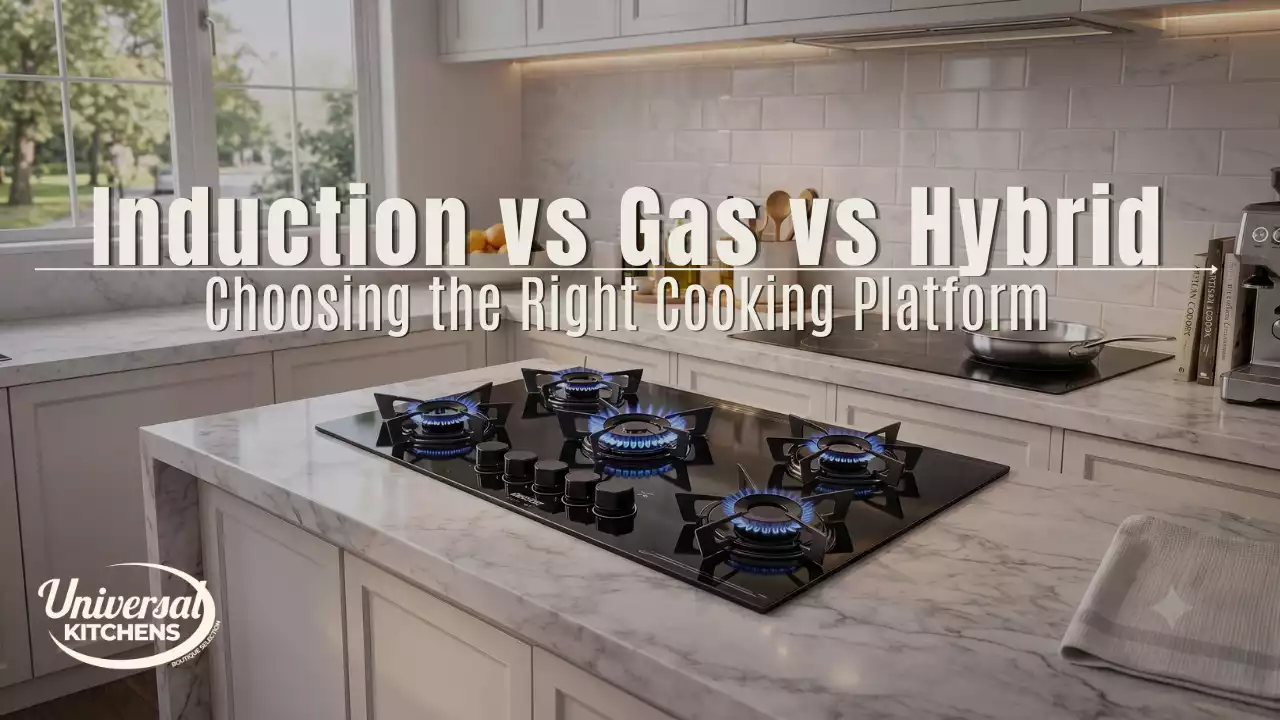
Hybrid sits between the two. It gives homeowners induction for daily cooking and a gas burner for specialised use. That is often the most elegant compromise for clients who are drawn to induction’s performance but are not ready to give up flame entirely.
Heat Control: Precision Versus Flame Feedback
Heat control is where induction often surprises homeowners who have long associated gas with professional cooking. Gas gives immediate visual feedback, but induction gives highly responsive, repeatable control. Once a cook learns the settings, it becomes easy to return to the same heat level for simmering rice, reducing sauces, searing meat or keeping delicate ingredients stable.
This matters in luxury kitchen design because the hob is not simply a tool; it is part of a broader lifestyle system. A beautifully designed kitchen should make daily routines feel intuitive. Induction’s digital control, rapid adjustment and smooth surface support that sense of ease.
Gas can still perform beautifully when properly specified, particularly on high-quality hobs with stable burners and refined flame adjustment. However, gas control depends on flame behaviour, burner design, pan distance and airflow around the hob. It is responsive, but not always as repeatable as induction.
Hybrid hobs offer a useful split. The induction zones handle the precise, everyday tasks; the gas burner becomes a deliberate choice for the moments when flame matters. For many premium South African homes, this offers the best emotional and functional balance.
Ventilation: The Hidden Design Decision
Ventilation is one of the most important differences between induction and gas. Every cooking platform needs extraction because cooking produces steam, grease, smoke and odours. However, gas adds combustion into the equation.
The US Environmental Protection Agency identifies gas stoves as an indoor source of nitrogen dioxide and recommends using an exhaust fan vented outdoors over gas stoves. It also notes that venting combustion sources outdoors and ensuring correct installation, use and maintenance are effective steps for reducing exposure.
This has direct design implications. A gas hob should not be selected late in the kitchen process as a simple appliance choice. It affects extractor specification, ducting routes, ceiling bulkheads, make-up air considerations, cylinder or line placement, shut-off valve access and compliance planning.
Induction still needs a well-designed extractor, particularly in open-plan kitchens and homes where entertaining is central. The difference is that induction avoids combustion pollutants, which gives designers more freedom to focus extraction on cooking by-products such as steam, grease and odours.
For a premium kitchen, the ventilation plan should feel integrated, not added. Universal Kitchens can design the hob, extractor, cabinetry, bulkheads and lighting together so the result feels intentional and architecturally resolved.
Safety and Compliance: Where Gas Requires More Planning
Induction has a strong safety profile because it heats cookware directly rather than relying on an open flame. ENERGY STAR notes that the cooking surface will not be hot to the touch without a pot or pan in place, and less heat is released into the kitchen compared with gas or standard electric cooking products.
The hob surface can still retain residual heat from the cookware, so it must be treated with care. But there is no open flame, no exposed burner, no gas cylinder in the cooking sequence, and generally less ambient heat around the cooking area. For family homes, multi-generational households and open-plan living, this is a compelling advantage.
Gas brings different responsibilities. In South Africa, gas installation must be handled correctly and signed off by the appropriate professional. SAQCC Gas states that only a registered Gas Practitioner can issue a gas Certificate of Conformity, and that a gas installation without a valid CoC is deemed illegal and may create liability risk for property owners.
This does not mean gas should be avoided entirely. It means gas must be designed and installed with the same seriousness as any other premium building system. The appliance, gas line or cylinder position, ventilation, cabinetry clearances and certification process should be considered from the earliest design stage.
Design Implications: Minimalism, Materials and the Luxury Kitchen Experience
From a design perspective, induction is the most seamless platform. Its flat glass surface works beautifully with modern stone, porcelain, sintered surfaces and minimalist cabinetry. It supports flush-fit or low-profile detailing, clean sightlines and easy wipe-down after cooking.
This is especially valuable in luxury kitchen design, where the island or cooking zone often sits in full view of guests. A gas hob, with pan supports, burners and control knobs, creates a more expressive culinary statement. That can be desirable in the right kitchen, particularly if the design language is bold, professional or chef-led. But it is visually heavier.
Induction also pairs well with solar-and-battery homes. For clients investing in energy resilience, appliance specification can be coordinated with inverter capacity, battery storage and circuit planning. The hob is not viewed in isolation; it becomes part of the home’s broader energy architecture.
Gas requires physical infrastructure that affects cabinetry and spatial planning. Cylinders or gas lines need compliant positioning. Shut-off valves must remain accessible. Extractor planning becomes more demanding. Pan supports and burners require deeper cleaning consideration. These factors are manageable, but they should be part of the kitchen design from the beginning.
Hybrid requires both electrical and gas infrastructure. That makes early planning even more important. A hybrid hob can be an excellent premium solution, but it is not something to add casually at the end of a project.
Hybrid Hobs: A Real Option for Premium South African Kitchens
Hybrid is not just a concept. Premium appliance formats available in South Africa include modular mixed-fuel layouts and hobs combining induction with gas. Bosch South Africa describes domino hobs as hybrid or mixed-fuel configurations that can combine gas and electric burners, while Smeg South Africa lists mixed hobs that combine one gas cooking zone with multiple induction zones.
The appeal of hybrid is emotional as much as practical. It allows a homeowner to enjoy induction as the main platform while retaining one gas burner for specific cooking rituals. For example, a client may use induction for 90% of daily cooking but still want gas for a wok, a flame-finished dish or an additional cooking option during a power interruption.
The trade-off is complexity. Hybrid requires careful coordination between electrical supply, gas compliance, ventilation and worktop cut-out specifications. It is a design-led decision, not just an appliance decision.
Choosing Based on Lifestyle
Choose induction if…
You want the strongest everyday cooking platform for a premium kitchen. Induction is ideal for homeowners who value speed, precision, cleaner lines, safer operation, reduced ambient heat and integration with solar-and-battery systems. It is especially well suited to open-plan kitchens in Gauteng estates, Garden Route coastal homes and Cape Winelands residences where the kitchen is a social, architectural feature.
Induction is also the best fit where the design brief calls for a sleek island, uninterrupted surfaces, handleless cabinetry, concealed extraction or a calm contemporary aesthetic.
Choose gas if…
You genuinely prefer open-flame cooking and are prepared to plan the infrastructure properly. Gas can still be appropriate for homeowners who cook with a wok, char ingredients directly, or simply love the visual and tactile experience of flame.
However, it should be selected with full awareness of ventilation, gas storage or line placement, shut-off access, professional installation and CoC requirements. Gas should be a specific lifestyle choice, not a default response to old load-shedding habits.
Choose hybrid if…
You want induction as the everyday workhorse but still want a gas burner for occasional flame-based cooking or added flexibility. Hybrid is particularly attractive for homeowners who appreciate modern design but do not want to feel limited by a single cooking technology.
It is best suited to new builds and major kitchen renovations, where electrical and gas infrastructure can be planned properly from the outset.
Induction First, Hybrid If Needed, Gas for Specific Use
For most premium South African homes, induction is the most future-facing cooking platform. It aligns with contemporary luxury kitchen design, supports cleaner sightlines, offers excellent cooking performance and integrates well with modern backup-power planning. It is the best default choice for homeowners who want a kitchen that feels refined, responsive and effortless.
A hybrid is the right choice when a homeowner wants the benefits of induction without letting go of flame entirely. It offers flexibility, but it must be designed early and professionally.
Gas should be reserved for homeowners who have a clear culinary reason for choosing it and who are committed to proper ventilation, compliant installation and ongoing safety awareness.
A well-designed kitchen is not built around a hob alone. It is built around the way people live, cook, entertain and invest in their homes. With the right guidance, Universal Kitchens can help South African homeowners choose a cooking platform that enhances daily performance, supports long-term value and completes the luxury design vision with confidence.