Skip to content

The Rise of the Full-Height Splashback
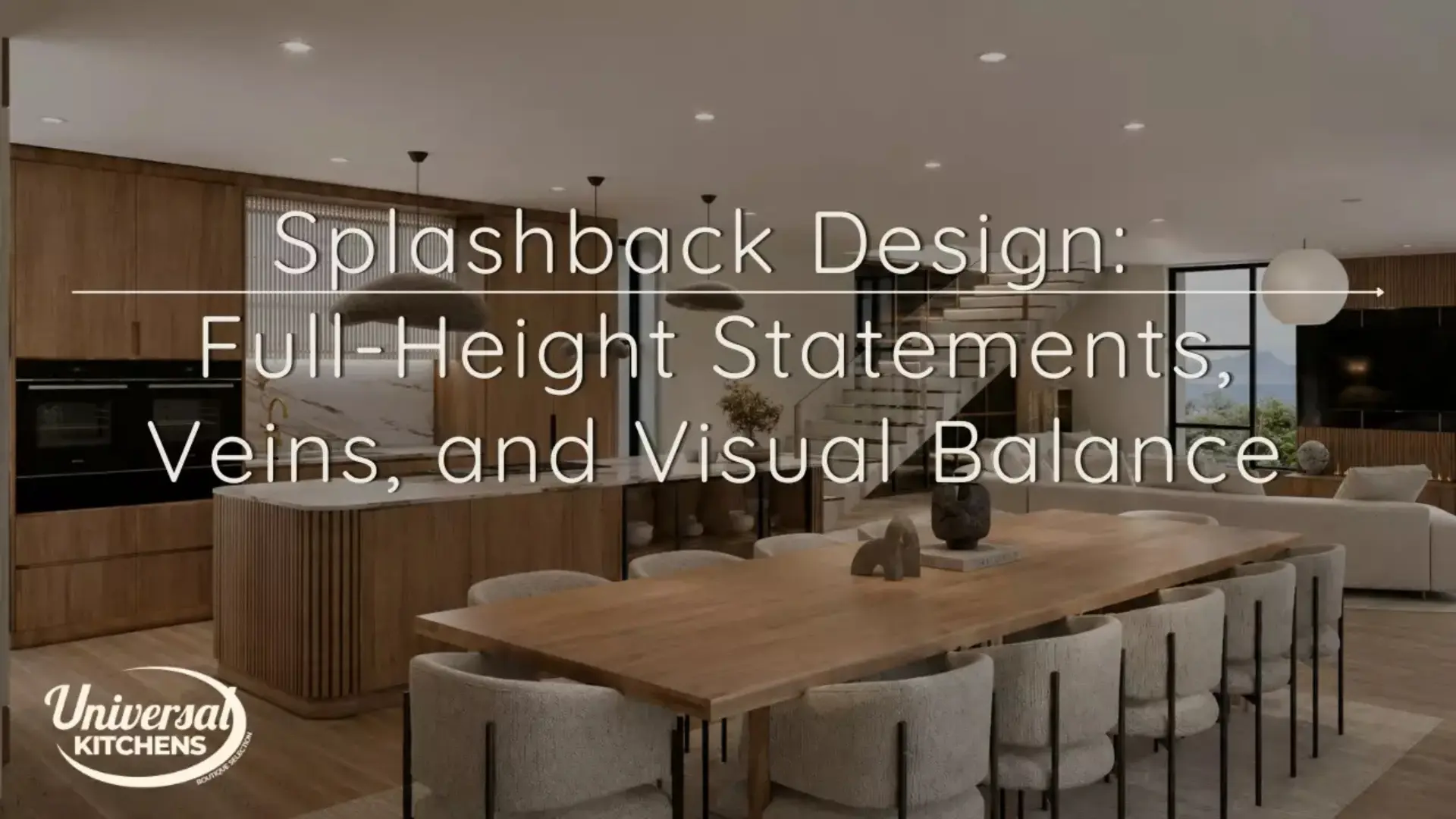
There was a time when a splashback was treated as a small, practical afterthought: a strip of tile behind the hob, chosen once the cabinetry and countertops had already settled the look of the room. That thinking has changed. In bespoke kitchens today, the splashback is increasingly a single, uninterrupted slab of stone that runs from the countertop all the way to the ceiling or the underside of the extractor, and it is treated as one of the most important design decisions in the entire room.
Design commentary heading into 2026 points firmly in this direction, with full-height slab splashbacks and veining-led palettes singled out among the standout kitchen trends of the year. Rather than stopping at a standard tile height, the material simply continues upward, closing the gap between countertop and wall units and giving the eye nothing to catch on except the movement of the stone itself.
The appeal is not purely visual. A single slab removes grout lines, tile joints, and the small seams that collect grease and steam around a hob. For homeowners investing in a kitchen meant to perform beautifully for fifteen or twenty years, that continuity is as much a maintenance decision as an aesthetic one. It also changes how a kitchen photographs and how it feels in person: a continuous surface reads as calmer and more architectural than a patterned or jointed one, which is precisely why it has become the signature move in so many contemporary, open-plan kitchens.
Reading the Stone: Veining, Movement, and Book-Matching
Once you commit to a full-height slab, the conversation shifts from “which tile” to “which piece of stone,” and that is a genuinely different design exercise. Natural stone and high-quality engineered surfaces are not uniform; each slab has its own veining, movement, and character, and the way that pattern is oriented and joined has a significant effect on the finished result.
Book-matching is central to this. The technique involves taking two adjoining slabs cut from the same block and opening them like the pages of a book, so the veining mirrors across the join and forms a continuous, almost symmetrical pattern. Houzz’s design coverage highlights book-matching as one of the reasons solid slab splashbacks feel so considered in open-plan kitchens, since the large-scale veining reads as a single deliberate composition rather than a repeated tile pattern.
Direction matters just as much as matching. Homes & Gardens’ reporting on the extended splashback trend notes that designers are paying close attention to whether veining runs vertically or horizontally, and to matching the thickness and orientation of the splashback material to the countertop, so the two surfaces feel like one continuous piece of stone rather than two separate decisions bolted together. A vertical vein can draw the eye upward and make a standard-height kitchen feel taller and more generous, while a horizontal, gently flowing vein can widen a run of cabinetry and suit a lower, more horizontal design language.
None of this happens by accident. It requires selecting the slab in person, marking out the cut lines against the actual kitchen layout, and planning the join location before a single panel is fabricated. This is where a bespoke process earns its keep: a supplier working from a catalogue photograph cannot guarantee the veining will land where it needs to on your wall, but a design team working from the physical slab can.
Bold Statement or Quiet Restraint: Choosing Your Approach
Not every kitchen calls for the same intensity of stone. One of the genuine design decisions in this space is whether the splashback should be the loudest element in the room or a calmer backdrop that lets other details lead.
A high-movement slab, with dramatic veining in a strong contrast to its base tone, works exceptionally well as a feature wall behind a hob or in an island run that faces into an open living space. In a Gauteng home where the kitchen opens directly onto a double-volume living and dining area, this kind of splashback becomes a genuine focal point, doing the job that a piece of art or a feature wall might do in another room. SA Decor & Design’s coverage of current stone trends points to exactly this shift: stone is increasingly used to create a deliberate feature wall or statement surface within the kitchen, rather than being confined to a purely functional strip.
A quieter, softly veined stone, by contrast, suits kitchens where the splashback needs to support rather than compete: a scullery or working kitchen behind a show kitchen, a smaller galley layout, or a home where the architecture, art, or a view already carries the visual interest. In the Cape Winelands, where many premium renovations sit within older or more traditional properties, a restrained splashback often works better than a bold one, allowing the architecture to lead while the kitchen simply feels considered and current.
The honest answer to “bold or restrained” is that it should be decided against the room, not against a trend. A dramatic slab in a small, enclosed kitchen can overwhelm the space, while a timid, low-movement stone in a large open-plan room can leave the kitchen feeling flat next to a generous island or a run of full-height cabinetry.
Balancing the Splashback with Cabinetry and Countertops
A full-height splashback only works if the rest of the kitchen is deliberately designed around it. This is one of the most common mistakes in less considered kitchens: a striking slab is chosen, but the cabinetry, countertop, and flooring are selected independently, and the result feels busy rather than luxurious.
The safest and most enduring approach is to let one surface lead. If the splashback carries strong veining and movement, the cabinetry should generally be calm: a solid colour or a very subtle, low-contrast timber tone, in either a handleless or lightly framed style, so the eye has somewhere to rest. If the cabinetry itself is the statement, perhaps a rich timber or a bold colour, the splashback should be quieter, allowing the joinery to take the lead instead.
Continuity between the countertop and splashback is equally important. Cosentino’s design-trend commentary describes this as the “total look,” where the same material carries across the worktop, splashback, and sometimes a breakfast bar or waterfall end panel, creating one continuous material story rather than a countertop and a splashback that were selected as separate decisions. This does not mean every surface in the kitchen must match. It means the surfaces that sit closest together, and are seen together in a single glance, should be planned as one composition.
This is also where the whole-kitchen view matters more than any single element. A splashback decision made in isolation, without reference to the cabinetry finish, the flooring tone, and the lighting plan, is very difficult to correct later. It is far easier, and far more effective, to resolve the splashback, countertop, and cabinetry together at the design stage, which is why this decision belongs early in the process rather than as a finishing touch.
Practical Considerations for a Seamless Finish
Behind the visual decision sits a set of practical ones that determine whether a full-height splashback performs as beautifully in year ten as it does on installation day.
Seam placement is the first consideration. Full-height panels are still limited by the size of the slab, so on taller walls, or where a window or extractor breaks up the run, a join is often unavoidable. The skill lies in placing that join somewhere it will not draw the eye, typically behind cabinetry, aligned with a corner, or positioned so the book-matched veining disguises it rather than highlighting it.
Material choice affects both the look and the long-term performance. Natural stones such as marble bring the most dramatic, individual veining but need to be sealed correctly and, in humid coastal conditions such as the Garden Route or the Cape Peninsula, resealed periodically to protect against moisture and staining around a working hob. Quartzite offers a similar natural-stone character with somewhat greater density and durability. Engineered surfaces, including quartz composites from brands such as Caesarstone and sintered stone surfaces such as Dekton from Cosentino, offer highly consistent veining reproduction, strong resistance to heat and staining, and, in the case of sintered surfaces, very low porosity, which suits humid, high-use kitchens without sacrificing the book-matched, large-format look.
Sealing and edge detailing deserve the same attention as the visible face of the slab. Any full-height installation around a working hob needs correctly detailed cut-outs for extraction, sockets, and splash zones, along with sealed joints where the stone meets the countertop and the cabinetry. These details are invisible when done well, which is exactly the point: a seamless finish should look inevitable, not engineered.
The Splashback as the Room’s Luxury Signal
Of all the surfaces in a kitchen, the splashback sits at eye level, catches natural light directly, and is seen in nearly every photograph and every glance across the room. That visibility is precisely why it carries so much weight in how “luxury” a kitchen reads, often more than the cabinetry or the flooring beneath it.
A well-chosen, well-matched, full-height splashback signals a kitchen that was designed as a single composition rather than assembled from separate choices. It tells a visitor, or a future buyer, that the veining was considered, the join was planned, and the surfaces were selected to work together rather than in isolation. That is a difficult quality to fake with a smaller, tiled splashback, however well the tile itself is chosen.
There is also a longer-term argument for treating this decision with care. Kitchen upgrades are widely recognised as one of the renovation categories most likely to be recouped at resale, with a well-designed, modern kitchen commonly recovering a substantial share of its renovation cost, according to Property24’s coverage of South African renovation return on investment. A splashback is a comparatively small part of an overall kitchen budget, but because it is so visually prominent, getting it right has an outsized effect on how the entire space, and by extension the home, is perceived.
For homeowners planning a bespoke kitchen anywhere in South Africa, from a Johannesburg entertainer’s kitchen to a Cape Winelands renovation, the splashback deserves the same early, considered attention as the layout itself. It is not the last decision to make once everything else is chosen. It is very often the decision that determines whether the rest of the kitchen feels composed, or simply assembled.
Frequently Asked Questions
Does a full-height splashback add value to a kitchen?
A full-height splashback is a visual and material decision rather than a functional addition, so it does not carry a value figure of its own. However, it contributes to the overall quality and cohesion of a kitchen renovation, and kitchen upgrades in general are widely evidenced to be among the renovation categories most likely to be recouped at resale in the South African market. The splashback’s role is to elevate how considered and well-designed the finished kitchen appears, which supports that broader picture rather than acting as a standalone investment.
Is a full-height stone splashback more difficult to maintain than tile?
A well-sealed slab has no grout lines to collect grease or steam, which generally makes daily cleaning simpler than with tile. The trade-off is that natural stone needs to be sealed correctly at installation and, in humid or coastal conditions, resealed periodically, while dense engineered and sintered surfaces require very little ongoing maintenance beyond routine cleaning.
Should the splashback match the countertop exactly?
Not necessarily, though continuity between the two is a strong current direction. Many of the most resolved kitchens use the same material across countertop and splashback for a “total look,” while others use a complementary stone or tone so the two surfaces feel related without being identical. The right choice depends on whether the cabinetry or the stone is meant to lead the room.